
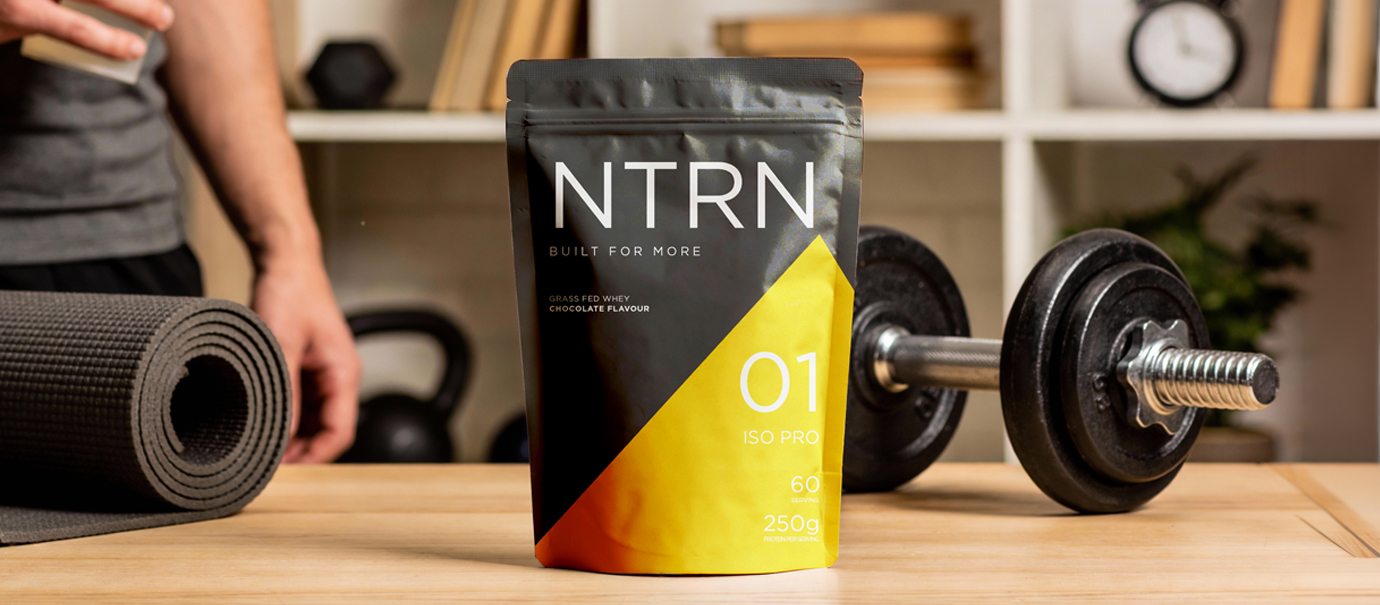
Picture a brand manager at a UK protein powder company. Her attention is pulled in several directions at once: reformulations, new flavour launches, marketing efforts and a push into mainstream retail.
The product is genuinely good, and gym sales reflect that. Then the brand lists on Amazon, and something doesn’t add up. Conversion rates are poor, and customer feedback keeps pointing to the same thing: the pack looks cheap. The product hadn’t changed; the shelf did.
Online retail has made packaging do a job it wasn’t always designed for. There’s no shop assistant, no physical shelf context, and no way to pick the product up. What’s there in its place is a thumbnail. A finite number of pixels competing with dozens of others, on a screen someone’s scrolling through at speed.
Brands in sports nutrition are increasingly realising that their packaging is their primary sales tool, and a lot of existing packaging wasn’t built for that role. When it comes to winning on the digital shelf, most sports nutrition brands are still warming up on the sidelines.
The format does the heavy lifting
Flexible pouches have become the format of choice for brands that understand this. The printable surface area alone changes what’s possible. Unlike a rigid canister with a
fixed label panel, a stand-up pouch offers a full front and back canvas. It’s a much fuller story on a digital screen, when a brand can carry its identity, its all-important product claims, its sustainability story, and its nutritional hierarchy in one coherent design. Printed on our Fujifilm Jet Press FP790 at 1200 x 1200 dpi with water-based inks, the colour accuracy and sharpness are good enough to stop a scroll.
Speed matters too, because sports nutrition moves fast. New flavours, reformulations, limited editions tied to events or athletes, compliance label updates: the packaging workflow has to keep up.
Digital printing removes the plate costs and minimum order quantities that make short runs commercially unworkable under traditional flexo. A brand can test eight flavour variants, proof all of them on the same day, and reach a go/no-go decision before committing to volume.
We know this from experience. When fruit and nut snack brand Whitworths came to us with 15 designs across its Mission Nutrition range, every artwork was signed off on the same day, in a single session at our manufacturing facility. Under a traditional flexo process, that would have taken weeks. That kind of pace doesn’t just save time; it changes what’s commercially possible.
That capability sits at the heart of our production site in Northampton. We were the first company outside Japan to install the Jet Press FP790, and demand has been strong enough that a second press is now installed and running alongside it. That doesn’t happen unless the market is genuinely ready, and in sports nutrition, it clearly is.
Don’t get caught offside on EPR
There’s also a regulatory reason to act now. UK EPR fees link packaging costs directly to recyclability through a fee modulation system. Multi-layer laminate pouches, which many supplement brands still use, attract higher fees because of their recycling complexity.
Recyclable monomaterial structures attract lower ones. For a brand spending meaningfully on packaging annually, that difference adds up. The brands moving to monopolymer pouches now are building the right cost structure and compliance position ahead of that pressure, not scrambling to respond to it.
The counterargument is performance. Monomaterial films have historically been seen as a compromise on barrier properties. That was a fair concern five years ago, but it isn’t now. High-barrier monopolymer structures are in use across dry food and powder
applications, delivering shelf life comparable to mixed-material designs. The transition doesn’t require accepting less, it requires working with a supplier like Eco Flexibles that knows how to specify the right structure for the product.
Better packaging won’t save a bad product. But right now, in one of the UK’s most competitive consumer categories, the brands pulling ahead are the ones treating packaging as part of their performance kit.