
Do little treats still have a place when budgets are tight? New research shows that they do – but consumers are choosing them more carefully.
Mintel’s The Connection Economy report suggests shoppers are still protecting those minor indulgences that add a little colour to everyday life, while becoming more selective about where they spend their money. For snack brands, that creates opportunity and pressure. They remain best placed to deliver an affordable moment of enjoyment, but potential purchases have to go the extra mile to earn consumer trust.
Packaging has a central role to play in that journey, but it’s a role that is growing increasingly complex.
The snack is becoming more than a snack
According to the Mintel report, snacking is becoming more closely tied to specific occasions. A product might be chosen for the morning commute, an ‘emergency’ stash in a desk drawer, a post-gym boost, or a film night with friends.
Each moment brings different expectations. A gym snack may need to signal protein, energy, and portion control alongside convenient functionality. A product bought for sharing may appeal more to a sense of indulgence, flavour, and generosity. In both cases, the pack must make the proposition clear within seconds to sway a snap purchasing decision.
This is where quality printing adds real value for snack brands. It enables the strongest packaging to identify the product’s most valuable role and communicate it confidently, using distinctive colour, sharp typography, and consistent print to build recognition.
Convenience is now part of the product
Print also plays a role in convenience, enabling consumers to quickly identify opening and reclosing mechanisms, for example. This is important. If snacks are now expected to fit around people’s routines, the packaging must do the same.
This means convenience is part of the product’s value. Reclosable pouches demonstrate this perfectly, turning one purchase into several snacking occasions. They support portion control, sharing, and on-the-go use while helping to keep the remaining product fresher for longer. Easy-open features, reliable seals, and a format that is simple to carry can all influence repeat purchase.
Delivering that kind of convenience is technically demanding. In the example of a reclosable pouch, the pack must open cleanly, reclose securely, and withstand repeated handling. Failing on any of these missions risks compromising product protection and the consumer experience.
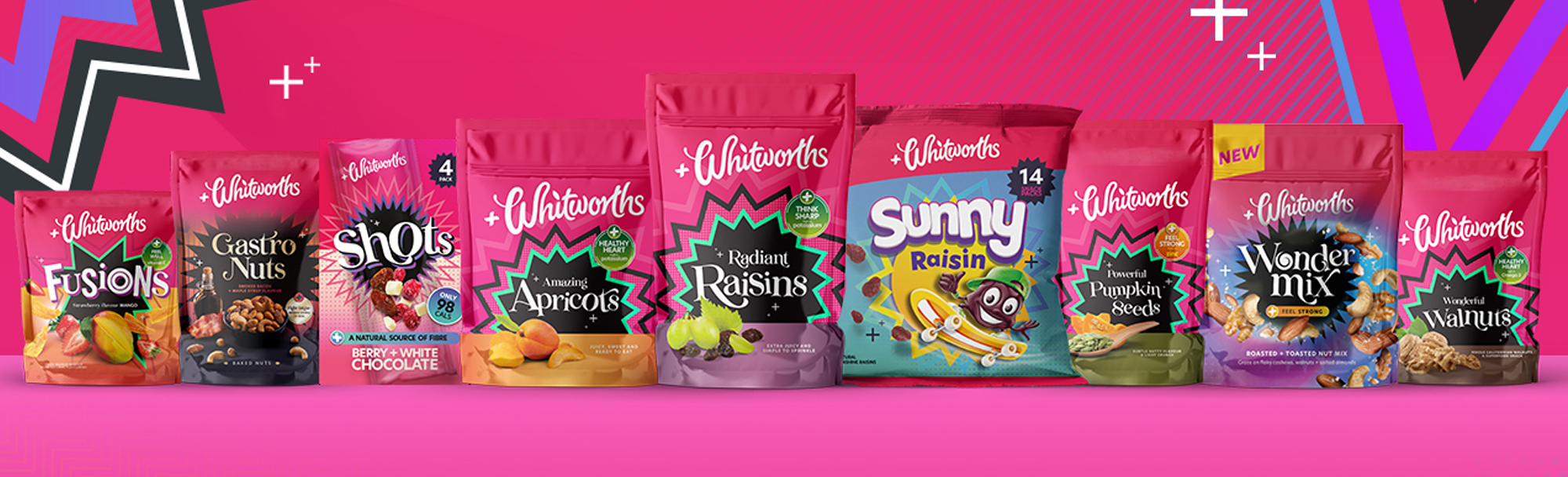
The packaging we developed for Whitworths Fusions, a range of dried fruit, nuts and seeds, highlights how flexible packaging expertise can overcome these challenges. The Eco Flexibles team created a high-barrier mono-polymer pouch with easy-open and reclose functionality. Its inverted stabilo format and extended fin seal helped create a reliable opening experience, reducing the risk of accidentally tearing through the entire pack. But it also provided strong shelf presence, while the structure met OPRL guidelines for mechanical recycling.
When sustainability meets shelf appeal
Increasingly, packaging must balance all of these traits. Moving to recyclable packaging shouldn’t mean accepting muted graphics. Brands need materials and print technologies that support circularity while presenting the product at its best.
For the Whitworths Fusions project, we combined a mono-PP structure with digital printing using water-based inks. This delivered vibrant, high-definition graphics without solvent VOCs, helping the range retain its visual impact while meeting its real-world recyclability goals.
The commercial value of strong design can also be seen in our work with Taste Original. The high-protein snack brand moved from a plain lidding film and label to a fully printed, high-barrier mono-material packaging design across its lidding film and snack bags. Digital print delivered sharper, more consistent graphics with a rapid turnaround, while the structure aligned with OPRL and CEFLEX recycling guidance.
Following the relaunch, Taste Original recorded a 15% uplift in food-to-go sales. These tangible results underline packaging’s ability to sharpen a product’s value proposition at a time when consumers are deliberating purchasing decisions more deeply.
Performance cannot be an afterthought
Consumers prefer sustainable packaging. This is proven by countless studies and surveys. But a ‘sustainable’ pack that fails to protect the food inside is not really a sustainable solution at all.
Snack packaging must maintain flavour, texture and freshness from production to the final serving. It needs the right barrier properties, puncture resistance and seal integrity for the product, filling process and supply chain. Any point of failure risks damaging consumer trust and creating both food and packaging waste.
This is where developments in mono-materials have made valuable progress. Carefully engineered mono-material structures can deliver strong barrier performance while being much easier to recycle than traditional multipolymer materials. And they can be used to create formats tailored with functional or high barrier performance, easy-open features, puncture resistance, and lap or fin seals. Specification, testing and accreditation are considered together, ensuring the pack is validated against the specific product’s demands rather than selected as a sustainability tick-box.
Selective spending is making every snack work harder to deliver all of this in a product that can be purchased and consumed within minutes. Consumers want a product that suits the moment, feels worth the price, and is easy to enjoy, while meeting growing expectations around packaging waste.
It’s a lot to pack into a small pouch or wrapper. But the answer isn’t to make the pack busier or more complex. It’s to make sure every element is considered with the snacking occasion front of mind.
In a market built around small moments of enjoyment, packaging has to be flexible in more ways than one.